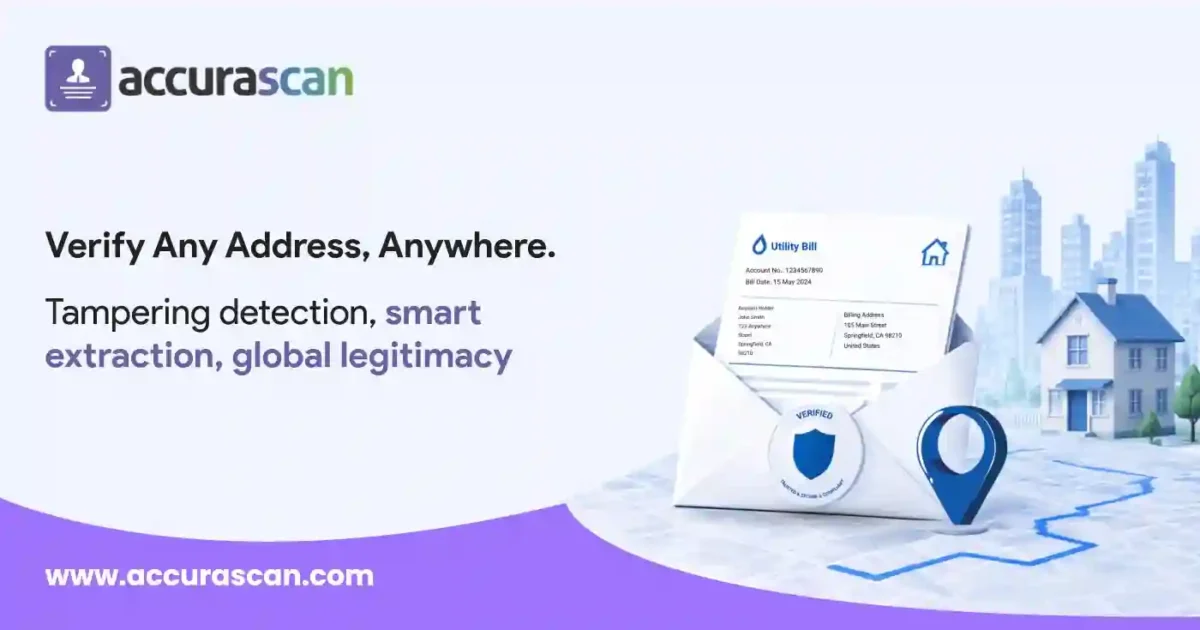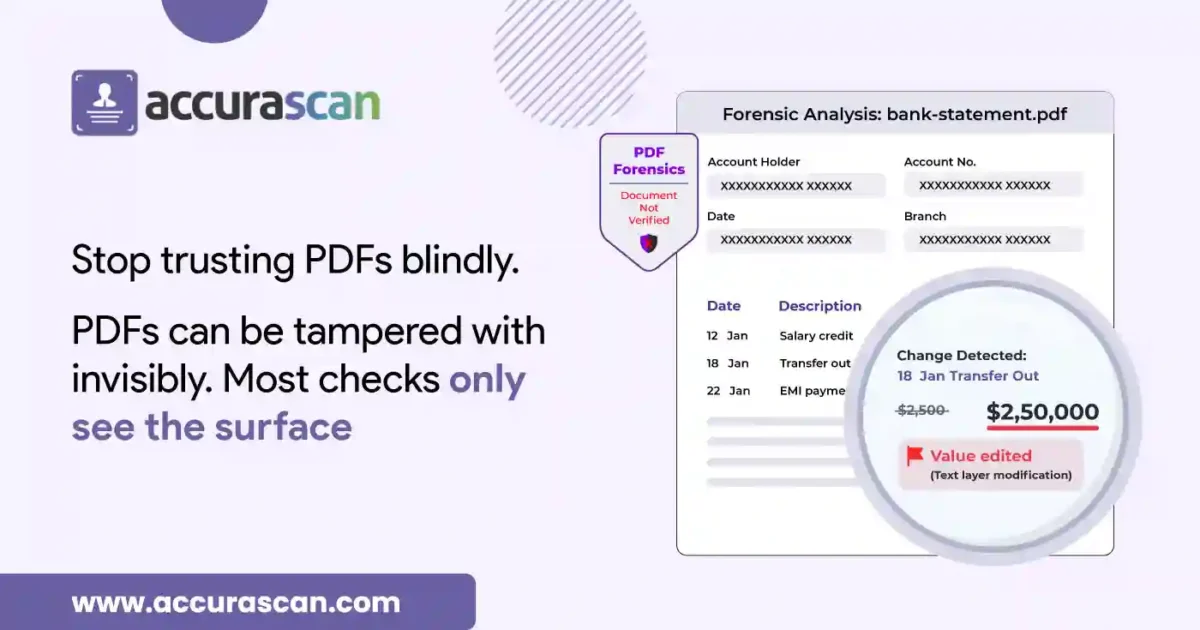
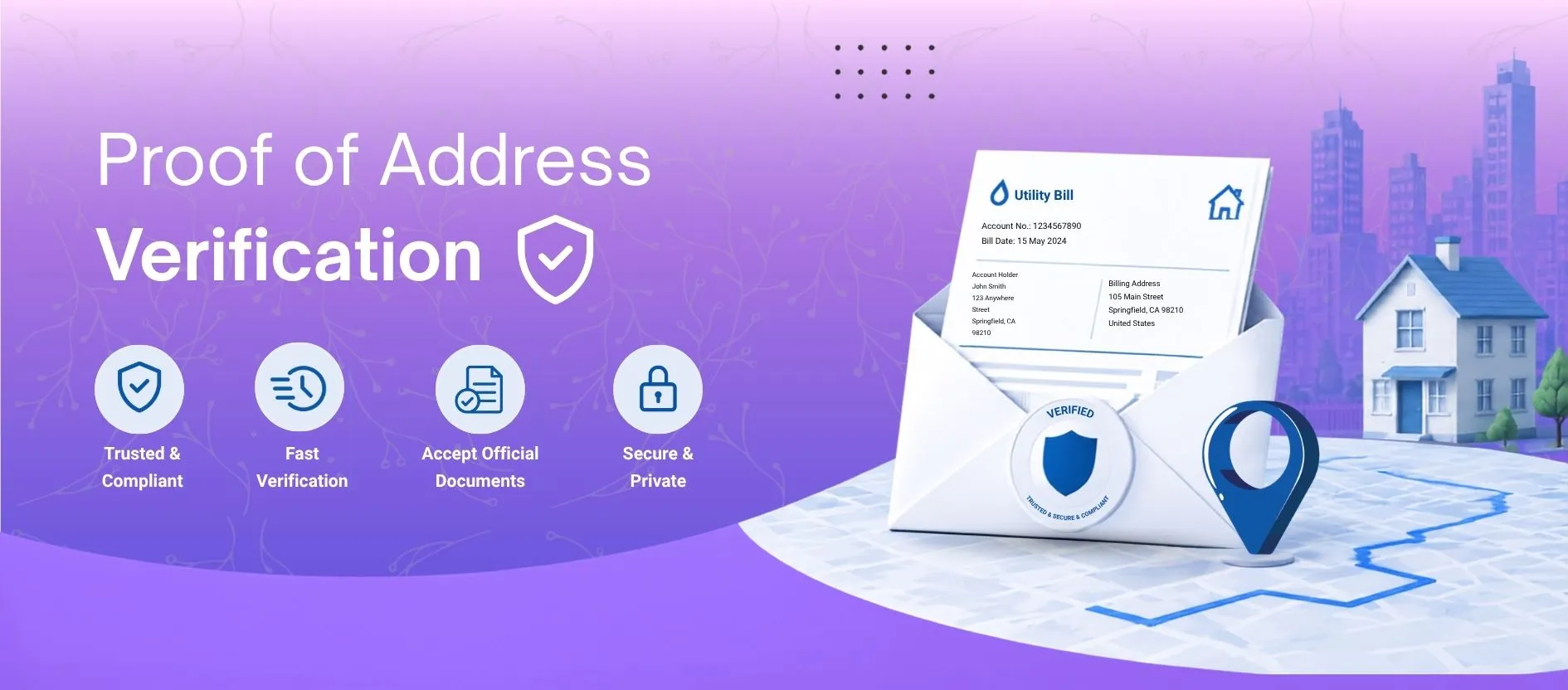



























Proof of Address is your end-to-end address verification engine, purpose-built for the demands of modern compliance workflows. Upload any address document and our system runs multiple sequential checks — tampering detection, intelligent address extraction, and global address legitimacy verification — returning a clean, audit-ready verdict in seconds.
For fintech, banking, lending, crypto, and regtech platforms, address verification is the weakest link in the KYC chain. A user uploads a utility bill, a bank statement, or a tenancy agreement — and your compliance team is expected to confirm multiple things at once: that the document is genuine, that the address on it is correctly captured, and that the address actually exists in the real world. Most KYC stacks check only one of these. Fraudsters exploit the gap.
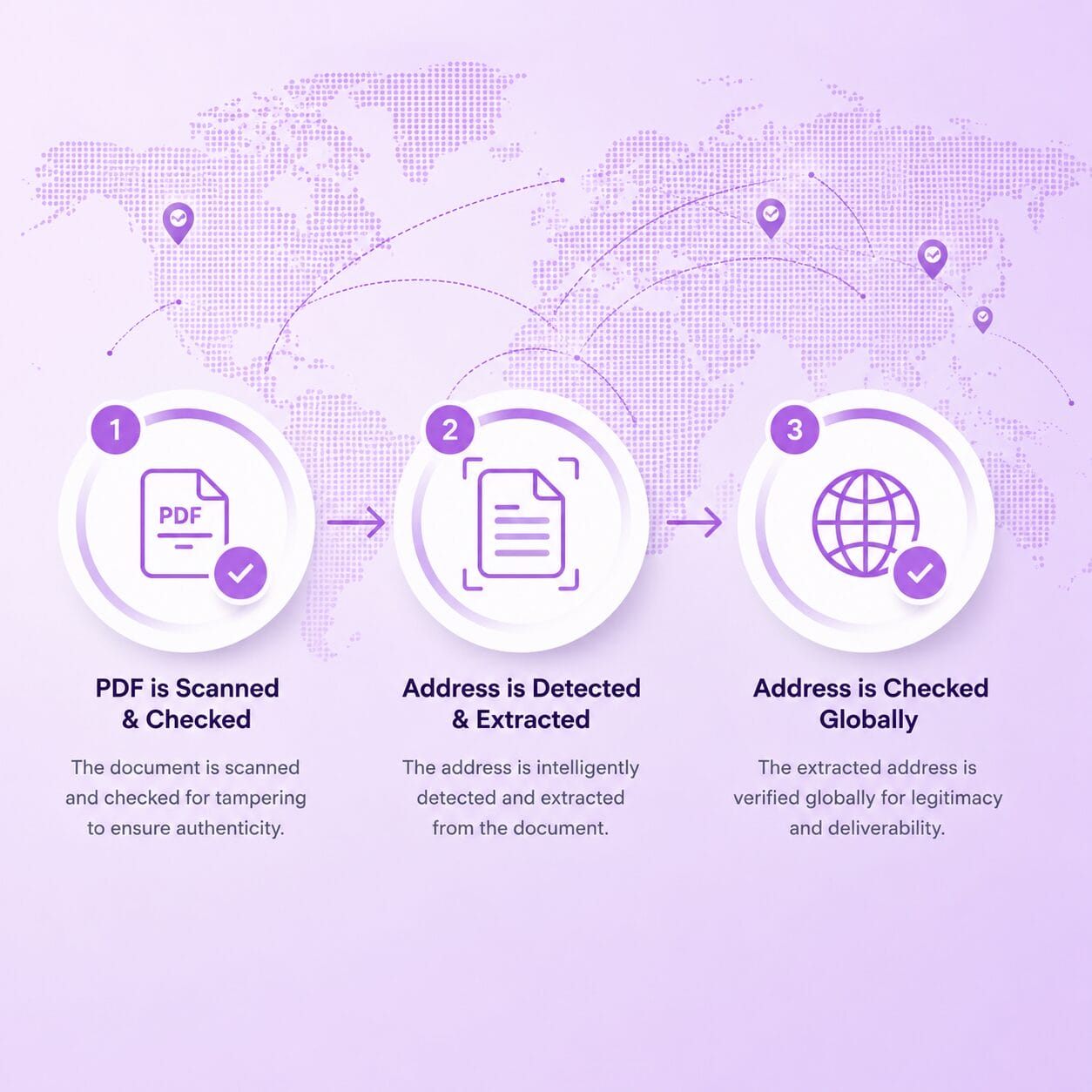
How Proof of Address Works?

Documents are examined for anomalies, inconsistencies, and manipulation

Our engine parses utility bills, statements, agreements and extracts the address

Addresses validated against comprehensive global datasets, confirming user-claimed locations

Tampering detection, extraction & legitimacy verification — unified
The Problem You’re Solving
Address verification is the most exploited weakness in retail KYC.
Unlike a passport or a national ID — which has chips, holograms, and machine-readable zones — an address proof is just a PDF. Anyone with basic editing software can change a name, swap a date, or paste a new address onto a real-looking utility bill. Document-only KYC workflows accept it. Manual reviewers don’t catch it. And the address itself is rarely validated against any real-world dataset.
The compliance gaps regulators are flagging:
- Forged utility bills generated from templates downloaded online
- Real documents with altered fields — name, address, or date swapped using common PDF editors
- Valid-looking addresses that don’t exist — fabricated street numbers, non-existent postal codes, or addresses outside the claimed jurisdiction
- No structured extraction — reviewers manually transcribe addresses into KYC systems, introducing typos and inconsistencies
- No audit trail tying the address decision to a verified document at the moment of onboarding
Manual review is slow, inconsistent, and expensive at scale. Even experienced KYC operators cannot verify whether a utility bill from a regional provider in Tier-2 India, the Philippines, or Nigeria is genuine.
Proof of Address closes that gap — multiple forensic checks in one API call, regulator-ready in seconds.
Where Proof of Address Makes a Difference
Banking, Neobanks & Account Opening
RBI, FCA, MAS, and equivalent regulators mandate verified address proof as part of standard KYC. Proof of Address sits inside the onboarding flow as a real-time check — accepting clean documents, rejecting tampered ones, and flagging borderline cases for review.
Lending, BNPL & Consumer Credit
Address fraud is one of the most common vectors for first-party lending fraud — a real applicant using a fabricated address to escape collection. Proof of Address validates the address against global datasets before disbursal, cutting bad-debt exposure tied to address fraud.
Telecom & SIM Onboarding
Operators issuing prepaid SIMs, eSIMs, and broadband connections must verify the customer's address as part of regulatory KYC. Proof of Address provides a real-time verdict during the onboarding flow.
RegTech Platforms & KYC Orchestrators
RegTech vendors and KYC orchestration platforms embed Proof of Address as a callable microservice — giving end clients in banking, insurance, and capital markets a single-vendor solution for the most fraud-prone step in the KYC funnel.
Government & Public Services
From welfare disbursement to subsidy programmes and tax registrations, government departments use Proof of Address to ensure eligibility checks are tied to a verified, real-world address.
Capital Markets & Brokerage
Demat openings, online trading, and robo-advisory platforms regulated by SEBI, SEC, and FCA all require verified address proof. Proof of Address integrates into onboarding alongside PAN, Aadhaar, or SSN-based checks.
Why Proof of Address
Built for Regulated Industries
Deployed across Tier-1 banks, neobanks, telcos, and government programmes — engineered to meet KYC, AML, FATF, and regional CDD requirements from day one.
Multiple Layers, One Verdict
Instead of stitching together a tampering checker, an OCR vendor, and an address validator, you get a single solution that runs all multiple sequentially and returns a unified decision. Less integration, less latency, less cost.
Global Address Coverage
Validates addresses across countries globally, normalised to local formatting conventions — UK postcodes, US ZIP Code, Indian PIN codes, Gulf P.O. boxes, all handled natively.